
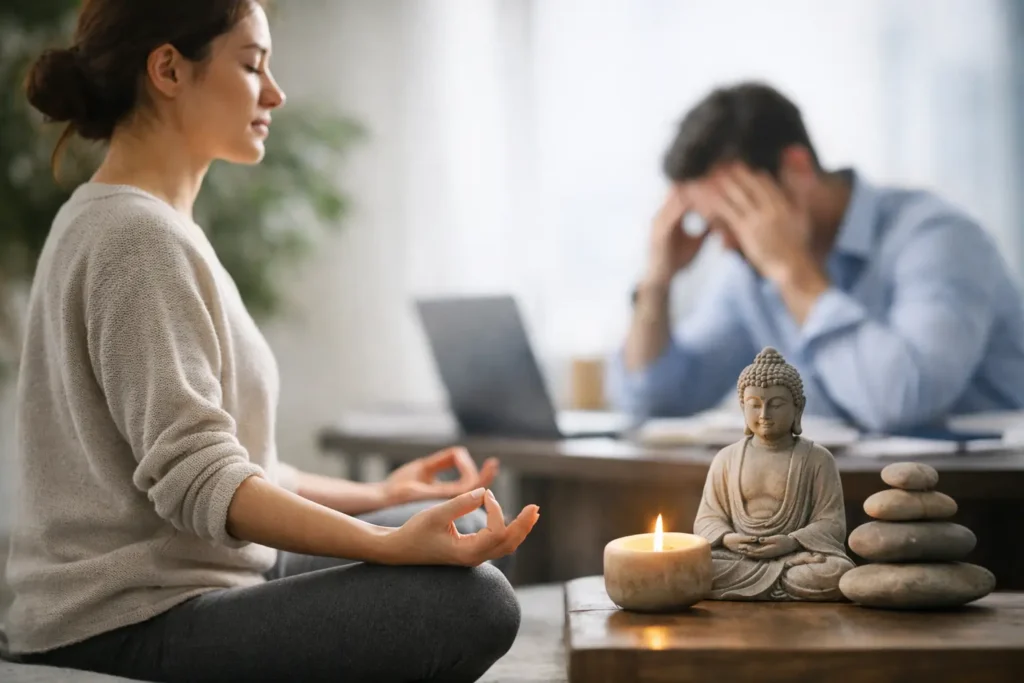
Emotional reactivity rarely announces itself as a spiritual problem. It usually appears as a sharp reply to a spouse, resentment toward a coworker, impatience with a child, or silent judgment during an ordinary inconvenience. Yet this is exactly where serious inner work begins. A spiritual discipline for emotional reactivity is not about appearing calm. It is about seeing, understanding, and dissolving the psychological causes that take possession of consciousness in daily life.
Many people want peace, but few want the rigorous observation required to discover why they lose it. In esoteric psychology, emotional reactions are not treated as random moods. They are expressions of conditioned elements within the psyche – anger, pride, fear, self-love, vanity, jealousy, wounded self-importance. These elements speak through us, justify themselves, and then leave us with consequences in relationships, work, and inner life. If we do not study them directly, spirituality remains theoretical.
Why emotional reactivity must be worked on spiritually
Modern culture often frames reactivity as stress management. There is some truth in that, but the spiritual view goes further. Reactivity is not only a nervous system event. It is also a revelation. It shows what in us still governs our words, thoughts, gestures, and intentions.
This is why emotionally charged moments are so valuable. They expose the distance between who we imagine ourselves to be and who is actually acting. A person may believe they are compassionate, patient, or conscious, yet one criticism is enough to unleash bitterness. That contradiction is not a reason for guilt. It is a reason for awakening.
A doctrine-based path does not ask you to suppress emotion or build a polished spiritual identity. It asks for self-observation in real time. The aim is to separate consciousness from the reaction long enough to comprehend what has been activated. Without that separation, we remain identified. We do not observe anger. We become anger.
Spiritual discipline for emotional reactivity in daily life
A true spiritual discipline for emotional reactivity must function in the middle of life, not outside it. If your practice works only in silence, but collapses in traffic, family conflict, deadlines, and disappointment, then your practice has not yet entered the field where transformation is required.
Daily life is the laboratory. Work exposes ambition and irritation. Marriage exposes expectation and possessiveness. Parenting exposes impatience and control. Friendship exposes comparison and sensitivity. None of this is accidental. Ordinary life is arranged with exact conditions for inner revelation.
This is why discipline matters more than mood. If you wait to practice only when you feel inspired, reactivity will continue ruling the moments that matter most. Serious development requires repeated acts of remembrance, observation, and inner correction.
Step 1: Interrupt the mechanical reaction
The first task is simple, though not easy. Do not immediately express what is boiling inside. This does not mean repression. It means creating a brief interval between stimulus and response.
That interval may last only a few seconds. You become aware of the tightening in the chest, the rush of justification, the desire to defend yourself, retaliate, or withdraw. In that instant, refrain from outward discharge. Speak less. Breathe. Stay physically present. If possible, postpone the conversation until you can observe more clearly.
Many spiritual students fail here because they confuse sincerity with impulsiveness. They think, “I am just being honest.” Usually, they are being mechanical. Real honesty requires consciousness, not release.
Step 2: Observe the reaction as an event within you
Once the initial surge has been contained, begin inner observation. What exactly was touched? Was it pride because you were corrected? Fear because you felt rejected? Self-love because you were not appreciated? The reaction itself is only the surface. The root is psychological.
The key is precision. Saying “I got upset” is vague. Saying “my vanity reacted because I wanted recognition” brings knowledge. This kind of observation weakens fascination and strengthens consciousness.
It also reveals that reactions often have hidden motives. Outrage may conceal wounded importance. Sadness may conceal attachment. Anxiety may conceal a demand for certainty and control. If you do not identify the specific inner factor, your work remains blurred.
Step 3: Reflect before sleep and after the event
Real-time observation is powerful, but post-event reflection is equally necessary. At night, review the day in sequence. Return to the scene where you reacted. Reconstruct it carefully. What words were said? What did you feel in the body? What thought justified the reaction? What image of yourself was being defended?
This review should be sober and exact. Do not dramatize. Do not excuse yourself. Do not condemn yourself. The aim is comprehension.
When done regularly, this exercise begins to show patterns. You may discover that the same reaction appears under different disguises: irritation when ignored, defensiveness when instructed, coldness when disappointed, sarcasm when insecure. These repetitions are not accidents. They indicate a stable psychological structure that must be understood and transformed.
Meditation and comprehension of the ego
Observation provides material. Meditation deepens understanding. Without meditation, self-study can remain superficial, intellectual, and repetitive. With meditation, one can penetrate the roots of a reaction and perceive how an egoic element forms, feeds itself, and steals energy from consciousness.
Take one strong reaction into meditation. Relax the body. Quiet the mind. Return to the emotional scene without identifying with it again. Let the memory arise as an object of study. Ask inwardly: what did this reaction seek? What was threatened? What false sense of self was defending its territory?
Do not rush toward an answer. At times, true comprehension comes as a direct perception rather than a chain of thoughts. You suddenly see that the anger was not about justice at all. It was wounded pride. Or that the sadness was not pure sensitivity, but possessiveness. Such seeing has force because it is verified in experience.
There is a trade-off here. Some people prefer techniques that soothe quickly. Meditation aimed at comprehension may not feel soothing at first, because it exposes uncomfortable truths. But exposure is mercy when it leads to liberation.
Prayer, transmutation, and conscious help
A disciplined path does not rely on personal will alone. Emotional reactivity is too deeply conditioned for that. One must also ask for inner help. In prayer, a student recognizes that understanding and elimination of defects require assistance from a higher principle within.
This is where spiritual work becomes devotional, not merely psychological. After observing and comprehending a reaction, pray with sincerity for the disintegration of the element that caused harm. Ask that consciousness be freed from that anger, fear, or pride.
If one works with sacred energy through disciplined transmutation, this process gains further strength. Energy that is usually wasted through mechanical living can be redirected toward inner transformation. Esoteric traditions have always taught that real change requires energy, not only good intentions.
What progress actually looks like
Progress does not mean you never feel emotion. It means you become less possessed by it. The trigger still appears, but there is more space, more lucidity, more capacity to refrain, observe, and act with intention.
Sometimes progress is visible in smaller signs. You recover faster after a reaction. You justify yourself less. You apologize more sincerely. You notice subtler forms of resentment before they erupt. These are not minor achievements. They show that consciousness is gaining ground over mechanical habit.
Still, progress is not linear. Under fatigue, illness, pressure, or family conflict, old patterns may return strongly. This does not mean the work has failed. It means deeper layers are surfacing. The correct response is renewed discipline, not discouragement.
A practical rhythm for serious students
Those seeking a structured path can work with a simple daily rhythm. In the morning, establish the intention to observe reactions without expressing them mechanically. During the day, use difficult moments as direct material for self-study. In the evening, review the events of the day and select one reaction for meditation and prayer.
This rhythm is modest enough to sustain, but serious enough to produce results over time. It turns life itself into a school. That is one reason platforms such as QS Universal Knowledge emphasize structured inner work rather than occasional inspiration. Transformation requires continuity.
If you take this discipline seriously, emotional reactivity stops being an obstacle and becomes instruction. Each reaction shows you where consciousness is asleep and where work must begin. Treated in that way, even conflict becomes useful, because it reveals the precise point where the soul still needs purification.
Do not wait for a more spiritual environment to begin. The next annoyance, the next criticism, the next frustration may be the exact lesson your inner work requires.