
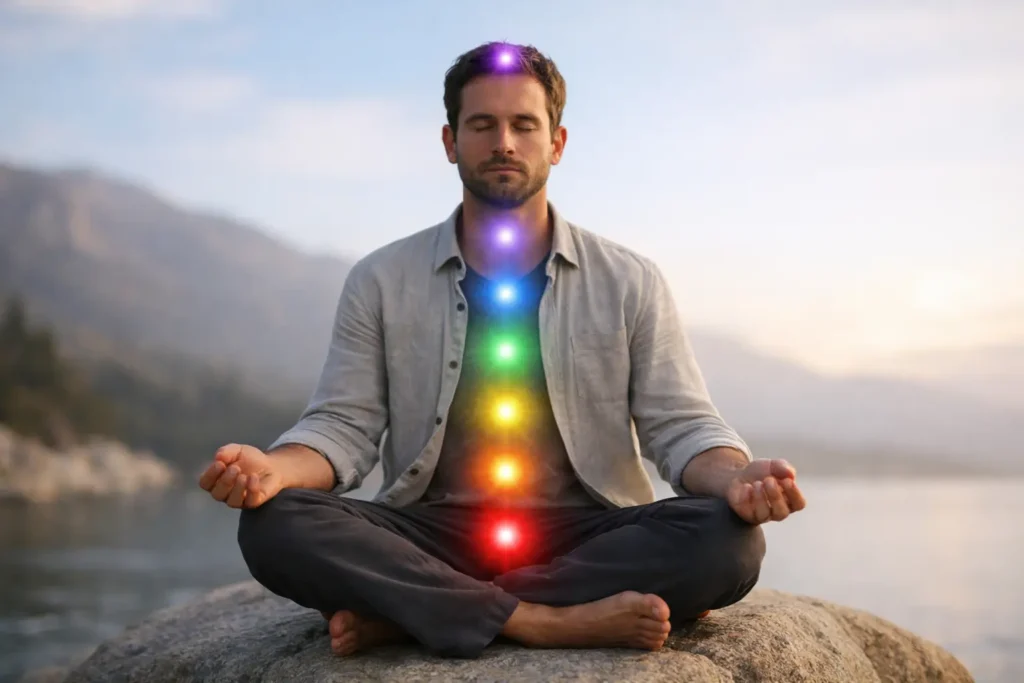
A person may pray, meditate, and read sacred books, yet still react with anger at work, vanity in relationships, and laziness when duty calls. This contradiction becomes easier to understand when we study the seven centers of man. They show that human life is not governed by one unified will, but by different functional centers that act, desire, think, and respond according to their own energies.
In esoteric psychology, this teaching is not presented as theory for curiosity. It is given so that a student can observe himself in real time. If we do not know which center is acting, we confuse instinct with intuition, emotion with devotion, and mechanical thought with conscious understanding. Then spiritual work remains vague. With clear knowledge of the centers, inner work becomes exact.
The seven centers of man in practical study
The seven centers of man are commonly explained as the intellectual, emotional, motor, instinctive, sexual, superior emotional, and superior mental centers. The first five belong to ordinary human functioning. The last two are higher capacities related to awakened consciousness.
These centers are not symbolic decorations. They are living fields of activity within us. Each one has its own speed, language, and function. Problems begin when they are mixed, exhausted, or usurped by psychological defects.
A person may try to solve an emotional wound only through analysis. Another may treat a moral issue as if it were merely instinctive survival. Someone else may waste sexual energy in fantasies and then wonder why meditation feels dry and weak. These are not small errors. They affect the quality of consciousness available in daily life.
The intellectual center
The intellectual center thinks, compares, plans, remembers, calculates, and forms concepts. It is useful and necessary. We need it for study, work, communication, and discrimination. But it easily becomes tyrannical.
When the intellectual center dominates everything, a person can explain spiritual truths without living them. He may know terminology, quote doctrines, and debate subtle points, yet remain inwardly asleep. The mind can describe humility while feeding pride. This is why self-observation is essential. We must ask not only, “What am I thinking?” but also, “Who is using thought, and for what purpose?”
The emotional center
The emotional center feels attraction, rejection, enthusiasm, sorrow, devotion, resentment, tenderness, and fear. It moves faster than the intellect and often governs behavior before thought catches up. In spiritual life, this center matters greatly because sincerity, reverence, compassion, and remorse all pass through it.
But ordinary emotion is mixed. What looks like love may contain attachment, jealousy, self-interest, or wounded vanity. What feels like righteous indignation may simply be pride defending itself. The student must learn to distinguish conscious emotion from negative emotion. This requires honesty, because many people justify their strongest reactions instead of studying them.
The motor center
The motor center governs movement, habits, gestures, learned skills, posture, speech patterns, and repeated behaviors. Driving, typing, cooking, and countless daily actions depend on it. Once trained, it performs with remarkable efficiency.
This center is deeply tied to mechanical life. We walk, eat, interrupt, scroll, frown, and speak in repetitive ways with very little awareness. For this reason, the motor center is a rich field for practice. If a student observes how he opens a door, sits in a chair, or responds physically during tension, he begins to see that sleep is not only in thought. It is in movement.
The instinctive center
The instinctive center regulates organic intelligence. It manages digestion, self-preservation, healing responses, fatigue signals, and many subtle functions of the body. It is wiser than our opinions in matters of basic survival.
Yet people often interfere with it through excess, negligence, or constant stimulation. Poor sleep, overeating, chronic anxiety, and addictive habits cloud perception. This has spiritual consequences. A disordered organism makes sustained practice harder. Serious inner work does not reject the body. It learns to cooperate with it responsibly.
The sexual center
The sexual center is one of the most powerful centers because it contains creative energy at the root of life itself. In authentic esoteric teaching, this center is not reduced to pleasure or repression. It is understood as sacred, potent, and decisive for transformation.
When sexual energy is squandered through fantasy, compulsion, or abuse, the personality becomes weaker and more fragmented. When treated with reverence, discipline, and purity, that same force can support regeneration, clarity, and deeper spiritual work. This is one reason serious traditions speak about chastity, transmutation, and responsibility with such gravity. The issue is not moralism for its own sake. The issue is energy.
Why the centers are usually out of balance
The ordinary person does not use the centers in a harmonious way. One center may do the work of another. The mind may try to manage emotional pain by endless reasoning. Emotion may interfere with clear judgment. Instinctive fear may disguise itself as spiritual caution. Sexual impulse may manipulate thought and feeling while pretending to be love.
There is also the problem of overuse. A person in modern life may spend long hours straining the intellectual center while neglecting emotional depth, bodily regulation, and conscious rest. Another may live in emotional drama and have little capacity for disciplined thought. Someone else may be dominated by motor and instinctive routines, existing almost entirely through habit.
This imbalance does not correct itself through belief alone. It must be studied through direct observation. During an argument, which center takes command first? During temptation, where does the energy move? During prayer, what interrupts recollection? These questions open the laboratory of daily life.
The higher aspect of the seven centers of man
The teaching of the seven centers of man does not stop with ordinary psychology. It points toward two superior centers – the superior emotional and superior mental. These are not developed by personality training alone. They belong to higher levels of being.
The superior emotional center is related to direct spiritual feeling, profound intuition, sacred awe, and forms of perception that are not produced by ordinary sentiment. The superior mental center is related to immediate knowledge, objective comprehension, and truth received without the slow process of discursive reasoning.
Many seekers imagine they are living from higher centers when they are only experiencing excitement, fantasy, or emotional suggestion. This is a common danger. The higher centers are not accessed through self-importance. They require purification, sacrifice, meditation, chastity according to the doctrine, and the gradual death of the ego.
It would be a mistake to chase higher experiences while neglecting the first five centers. If a person cannot observe anger, vanity, gluttony, haste, and mechanical speech in ordinary situations, claims about higher consciousness are premature. The path is vertical, but it begins where we stand.
How to work with the centers in ordinary life
Real study begins with self-observation without justification. At work, observe whether your speech is driven by thought, emotion, habit, or hidden self-love. In family life, notice how quickly emotional reactions take over and how the motor center repeats the same gestures and tones. During meals, examine instinct, appetite, and automatic behavior. In moments of attraction, study the movement of the sexual center with sobriety.
Meditation deepens this process because it lets us review events and discover what happened beneath the surface. A tense conversation may appear simple when remembered intellectually, but in meditation we may see wounded pride in the emotional center, unconscious gestures in the motor center, and instinctive contraction in the body. Then observation becomes more precise.
This precision matters because transformation is not vague improvement. It is the progressive purification and right use of energies. If you know which center is being abused, you can begin to correct it. If you see which defect is feeding on that center, the work becomes even more exact.
For students who want a structured method for this kind of inner study, QS Universal Knowledge teaches these principles within a broader curriculum of self-observation, meditation, dream work, and conscious transformation in daily life.
A disciplined view of the seven centers of man
The value of this teaching lies in its demand for sincerity. It shows us that we are multiple, mechanical, and often divided against ourselves. At first, this can be humbling. Yet it is also hopeful, because what is observed can be worked on.
Do not approach the seven centers as an abstract map to memorize. Approach them as mirrors that reveal how you live from hour to hour. When you begin to see which center speaks, reacts, consumes, fears, or prays within you, daily life stops being random and becomes the very ground of awakening.