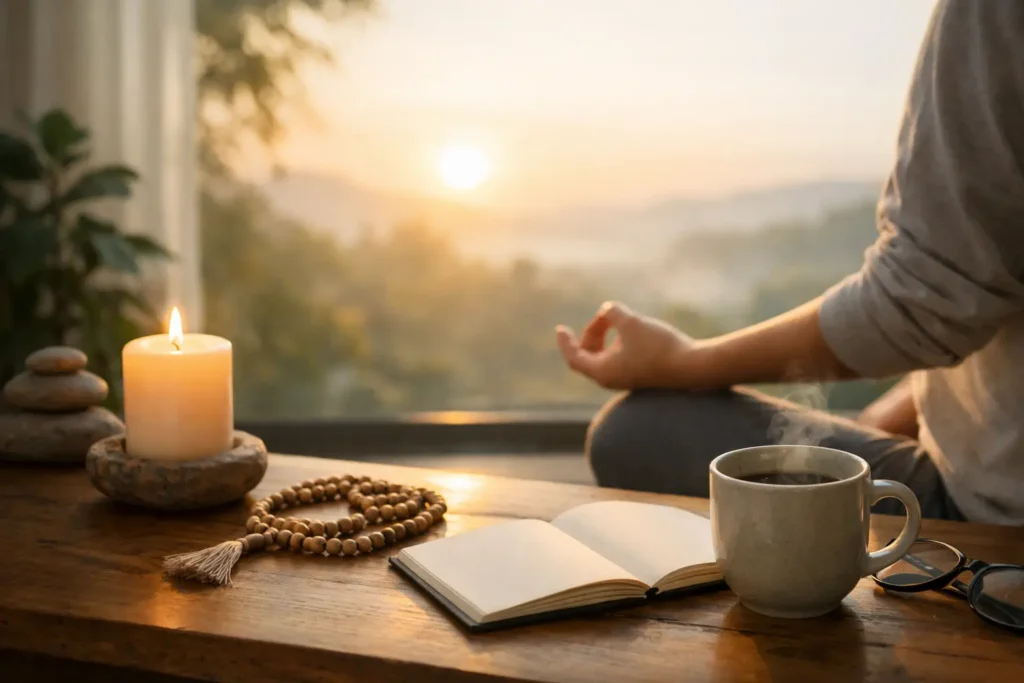

A person can pray in the morning, meditate at night, and still pass the entire day asleep in habit. This is why reflection pauses during the day matter. They interrupt mechanical living and restore the central task of spiritual work – to remember oneself in the middle of action, relationship, pressure, and routine.
Many people imagine inner development as something reserved for a cushion, a temple, or a quiet hour before bed. Yet the most revealing classroom is ordinary life. The way we answer a message, react to criticism, hurry through a meal, or defend an opinion shows our actual level of consciousness more clearly than our ideals do. A brief pause, made with sincerity and precision, can expose an entire chain of thoughts, emotions, tensions, and impulses that usually pass unnoticed.
Why reflection pauses during the day matter
A reflection pause is not simply a break to relax. It is a deliberate act of inner recollection. For a few moments, one stops external momentum and observes what is happening within. What am I thinking? What emotion is active? What desire is moving me? What tension is fixed in the body? Am I identified, offended, anxious, proud, rushed, or fantasizing?
This practice belongs to the discipline of self-observation. Without self-observation, spiritual study remains theoretical. A person may speak about consciousness, karma, ego, or awakening, yet continue reacting in the same mechanical ways. Reflection pauses create small openings in the day where knowledge can become direct verification.
They also correct a common imbalance. Some seekers collect teachings but do not apply them in the instant when anger appears, when vanity seeks approval, or when fear contracts the heart. The pause returns doctrine to its true field of work: this moment, this impression, this reaction. It is here that transformation begins.
What a true pause is and what it is not
A true pause is active, not dreamy. It is not scrolling for relief, spacing out, or taking a few seconds to indulge self-pity. It is also not a vague mindfulness exercise detached from moral effort. In authentic inner work, observation has purpose. One seeks to know the state of the psyche, to separate from mechanical reactions, and to prepare the ground for conscious change.
For that reason, these pauses should be brief but exact. If they become too loose, they lose force. If they become too rigid, they may create strain or self-condemnation. The right measure is alert sincerity.
It also helps to understand that a pause is not yet transformation. It reveals material. It shows what is present. That alone is valuable, but it is only the first movement. Seeing irritation is not the same as dissolving it. Recognizing vanity is not the same as freeing oneself from vanity. Still, one cannot work on what one never notices.
How to practice reflection pauses during the day
The most effective method is simple enough to sustain. Stop for a short moment at fixed times or key transitions – before starting work, after a difficult conversation, before eating, upon entering the home, before sleep, or whenever a strong impression hits. Do not wait for perfect conditions. Daily life itself is the practice field.
Begin by becoming still for a few seconds. Relax the body without collapsing attention. Observe the breath naturally. Then ask inwardly, with firmness and humility, what is happening in me right now?
Look in three directions. First, examine thought. Is the mind racing, rehearsing, comparing, judging, fantasizing, or justifying? Second, examine emotion. Is there resentment, enthusiasm, fear, sadness, impatience, or hidden bitterness? Third, examine impulse and posture. Is the body tense, hurried, heavy, defensive, or seeking pleasure?
Do not explain everything. Do not build a story. Name the fact inwardly and remain present to it. “I am irritated.” “I want recognition.” “I am afraid of losing control.” “I am dispersed.” This direct naming weakens identification because it introduces consciousness into the mechanism.
If your spiritual practice includes prayer or interior invocation, this is an appropriate moment to ask for help in understanding and transforming what has been seen. The pause then becomes more than observation. It becomes cooperation with inner work.
A four-part framework for daily use
To make the practice stable, it helps to use a clear framework.
First is stopping. Interrupt the chain of automatic action, even for ten or twenty seconds. Without stopping, there is no space for consciousness.
Second is recollection. Gather attention from external distractions and remember the fact of your own presence. You are here, in this body, in this circumstance, responsible for your state.
Third is diagnosis. Observe the dominant thought, emotion, and impulse. This is not psychological entertainment. It is spiritual inventory.
Fourth is redirection. Continue the activity, but with more sobriety, watchfulness, and inner restraint. If a correction is possible, apply it immediately. Speak less harshly. Slow the pace. Refuse the complaint. Remember the aim.
This four-part rhythm can be practiced many times a day without disturbing ordinary responsibilities. In fact, it makes work, family life, and service more conscious.
Where these pauses reveal the most
Not every moment has the same value for self-knowledge. Reflection pauses are especially useful in moments of friction. Pressure reveals what comfort hides.
At work, a pause after receiving criticism can uncover pride, insecurity, or the craving to appear competent. In family life, a pause before answering a loved one can reveal accumulated irritation or emotional demands disguised as concern. In solitude, a pause can expose dispersion, fantasy, laziness, or subtle forms of sadness that fill the mind when no external stimulus is present.
Pleasant moments also require observation. Success can inflate vanity as quickly as conflict awakens anger. Praise, attraction, comfort, and excitement all deserve the same lucid attention. A serious student does not only study suffering. One studies all impressions, because the ego expresses itself through the agreeable as well as the painful.
Common mistakes in the practice
One mistake is turning the pause into self-criticism. The purpose is not to crush oneself but to see oneself. Moral seriousness is necessary, but guilt without comprehension becomes another form of identification.
Another mistake is inconsistency. A person may practice intensely for two days and then forget for a week. Inner development requires rhythm. Short, repeated pauses are usually more effective than occasional dramatic efforts.
A third mistake is trying to solve everything in the moment. Sometimes the pause reveals material that should be studied later in meditation, prayer, or retrospective review. During the day, the task is often to see clearly, avoid feeding the reaction, and remain inwardly available.
Finally, some people pause only when distressed. That is understandable, but incomplete. A trained consciousness learns to observe before, during, and after events. This wider arc gives better understanding of causes and patterns.
Making the day itself part of the path
When practiced faithfully, these pauses begin to reorganize daily life. The day no longer appears as an obstacle to spirituality, but as its testing ground. Commutes, meetings, meals, disappointments, and conversations become occasions to awaken from psychological sleep.
This approach is deeply practical because it does not ask you to escape your obligations. It asks you to inhabit them with greater consciousness. For those studying a structured path of inner development, such as the teachings shared by QS Universal Knowledge, this is essential. The work is not to admire higher truths from a distance, but to verify them in the laboratory of living experience.
Over time, reflection pauses produce a subtle but profound change. One begins to notice reactions earlier. Speech becomes less impulsive. Impressions lose some of their power to drag the mind and emotions in every direction. This does not happen overnight, and it does not unfold in a straight line. Some days will feel clear, others heavy and mechanical. That is normal. The discipline is to continue.
If you want these pauses to bear fruit, keep them simple, exact, and sincere. A few seconds of real self-observation are worth more than long periods of vague introspection. Every pause is a chance to remember why you are here, what in you must be understood, and what kind of consciousness you are trying to cultivate. The day is already speaking. Learn to stop long enough to hear it.